Bargaining for Nirvana: The Caddy and The Lama
by Bruce A. Markell
William S. Boyd School of Law
At a family reunion when I was a kid, I had an uncle that made me memorize a scene from his favorite movie. While its significance has eluded me for several years, I think that our Contracts class offers some insight into the passage.
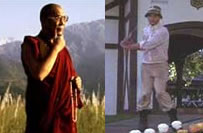
Bill Murray as Carl Spackler, a delusional, pyromaniacal caddy in the movie Caddyshack, recounts his transcendental experience of caddying for the Dalai Lama in a little grandstanding for other caddy underlings. Towards the end of the golf, Carl allegedly approached the spiritual leader for a tip. In his own words:
“So I said, ‘Hey Lama, how about something, you know, a little extra – for the effort?’ He said, ‘There will be no reward; but on your deathbed, you will have gained total consciousness.’ So I got that going for me, which is nice.” [1][1]
This interchange between one of the great caddies of all time and the famed spiritual leader raises several contract questions. Did Carl just make a contract for spiritual enlightenment with the Dalai Lama? Was there classical offer and acceptance? Is consideration satisfied? Assuming formation occurred, what defenses might the Dalai Lama have and what recourse would Carl have in the event of breach? Under the guiding light of Professor Markell’s course, I think we can proffer some explanation and clear up the mystery that has haunted me for nearly two decades.
Analysis: Offer
As Carl approaches the Dalai Lama at the end of their golf relationship, Carl attempts to “sweeten his deal” by inducing the Dalai Lama to give him a tip. In essence, Carl is asking the Lama to make him an offer of remuneration in addition to his salary. In response, and in light of an assumed understanding that Carl is asking for an immediate financial commitment, the Lama declines to give Carl any money, but instead “offers” him what appears to be spiritual enlightenment, or at least the confirmation of such at a future point in time.
R2K §24 defines an offer as a manifestation of willingness to be bound to a bargain, so made as to justify another in believing their assent is requested, and will conclude the deal. Carl will argue that the Lama has, indeed, given him an offer; while the Lama has specifically rejected the immediate cash request, he has offered in its stead a future gift of “total consciousness.” As a result, we can assume that Carl believes that the Lama has responded to his request with an offer that substitutes his originally suggested mode of payment. However, the Lama may argue that he did not make an offer, but was simply attempting to show the vanity of Carl’s request in light of the eternal. The Lama may also argue that he is not offering Carl anything, but that he was simply trying to predict the end result of Carl’s terrestrial sojourn.
In addition, the Lama may argue that the offer lacked certainty. R2K § 33 requires that an offer be sufficiently certain in order to be valid. For example, the Lama may argue that the offer was uncertain because it did not provide a basis for determining breach or an ensuing remedy (R2K §33(b)); given Carl’s semi-lucent state when healthy, “total consciousness” on his deathbed may be an extremely ephemeral judgment call, at best. Carl might counter this argument with testimony that he was willing to take any type of “total consciousness” he could get, or that he and the Lama understood one another as to what total consciousness might entail. The Lama might also argue that several terms of the bargain were left open, including a more precise definition of “total consciousness,” the exact time for performance (e.g. when will Carl be upon his deathbed?), the duration of “total consciousness,” etc. The open terms, as the Lama might argue, tend to show that an offer was not intended, and that Carl therefore had no ability to accept. Carl might attempt to supply U.C.C. gap-filling provisions to qualify the offer; however, while the exact nature of “total consciousness” is undisclosed, it more likely than not falls outside the world of “goods,” thereby barring Carl from such qualifying amendments of the statutory supplement.
Acceptance
Assuming that an offer can be construed, the question remains: did Carl accept the Lama’s offer? Carl’s recount of the event does not shed further light on the nature of his acceptance, at least at the time the original offer was extended. However, Carl seems clearly to have accepted, as evinced by his assertions that he is looking forward to enjoying the promised total consciousness. R2K §50(a) defines an acceptance as a manifestation of assent to the terms of an offer by the offeree made in the manner required or invited by the offeror. R2K §50(b) further requires that a unilateral offer be accepted by at least part performance. In Carl’s case, we can infer that he dutifully and faithfully caddied for the Lama, as demonstrated by the Lama’s offer. Thus, Carl seems to have completely fulfilled the requirements of acceptance.
What if Carl didn’t verbally accept the offer: is his acceptance still valid? R2K §69 allows an offeree to accept by silence where the offeror has given reason to understand that assent may be expected by silence and the offeree intends to accept the offer by remaining silent. First, we look to the Lama’s alleged offer. Clearly, given Carl’s statements indicating acceptance, it appears that Carl is planning on receiving “total consciousness” on his deathbed, thereby accepting the offer. The Lama may argue that he did not give Carl reason to understand that Carl could accept by silence. However, the Lama’s statement doesn’t seem designed to illicit a response, which may validate Carl’s belief that none was required.
Consideration
Assuming a valid offer was given by the Lama and there was an acceptance of that offer, was there valid consideration for the agreement? §71 states that, in order to constitute consideration, a performance or return promise must be bargained for. At first blush, we might conclude that Carl is bargaining for his services with the Lama. However, Carl’s services appear to be concluded, since his story seems to recount his final moments with the Lama. In that case, the Lama will argue that he made Carl a gift, and that Carl did nothing in return for that gift, thereby frustrating valid consideration.
Even if Carl had the conversation with the Lama in the course of their golfing, Carl may be barred from requesting additional consideration. §73 denies the validity of consideration where the offeree bargains with a return exchange of performance of a pre-existing legal duty, unless the remaining performance differs from that required originally under the duty. Given that Carl was in the performance of service with the Lama, Carl may be unable to argue that his ensuing performance would qualify as consideration in the form of a valid return performance. However, if Carl is able to show that the Lama’s promised “total consciousness” fundamentally altered the nature of Carl’s ensuing service (e.g. Carl can show that the Lama offered total consciousness in exchange for five additional mulligans), then Carl’s remaining performance would qualify as valid consideration.
While Carl may be able to prove his performance is valid, the Lama may argue that his consideration (e.g. total consciousness) is inconsonant with that offered by Carl (e.g. caddy services, be they extraordinary and otherworldly or no). However, under R2K §79, once the requirement of consideration is met, there is no additional requirement that the considerations be of equal value. Given that both have given something of real value, the Lama’s argument may fail.
Even if Carl’s arguments as to the validity of his consideration fail, he may be
able to invoke promissory estoppel as a consideration substitute. §90 allows that a promise that the promissor should reasonably expect to induce action or forbearance on the part of the promissee is binding to the extent that injustice can be avoided where the promissee does actually rely on the promise. While the Lama may argue that he did not reasonably expect Carl to rely on his promise, Carl will argue that the Lama is a world-renowned spiritual figure of such importance that he should have expected Carl’s reliaince on his promise. However, in order to lay claim to the Lama’s promise, Carl must have actually relied upon that promise; Carl will be required to affirmatively show that he is indeed relying on the promised enlightenment. Carl may attempt to show that he has degenerated into riotous living while believing that in the end he will still experience total consciousness, regardless of his actions over the remainder of his life. Also, even if Carl relies on the Lama’s promise, the resulting benefits that Carl receives may be short of “total consciousness,” since § 90 protects the reliance only “as justice may require.” As a result, Carl may have to settle for a moment of “semi-consciousness,” “lucidity,” or even just a “mild buzz” on his deathbed, instead of the promised euphoria of “total consciousness,” depending on what justice requires to protect his reliance.
Defenses and Remedies
Assuming that there was a valid contract formed between Carl and the Dalai Lama, the Lama may have a cadre (note: not a pun) of defenses with which to refute Carl’s claims. For the sake of the following, we will disregard the fact that Carl will be unaware of breach until on his deathbed, a point at which presumably Carl’s assertion for breach may be involuntarily “extinguished,” at least as to local jurisdiction.
§§ 152-154 Mistake. The Dalai Lama may assert that he mistakenly stated “total consciousness” when he intended a different meaning. § 152 provides that where two parties to a K both make a mistake, the adversely-affected party may void the K if (s)he doesn’t bear the risk of mistake. Here, a mistake as to the nature of “total consciousness” probably goes to a “basic assumption” on which the contract was made. And while the Lama will still need to show that he didn’t assume the risk of mistake, such a mistake would have a material effect on the agreed exchange of performance. In a similar vein, § 153 provides that, where only one party is in mistake, the adversely-affected party may void the deal if the mistake makes enforcement unconscionable or the other party had reason to know of the mistake. Here, Carl may argue that, even if he alone was mistaken, the mistake was of such import that it would be unconscionable not to have the Lama bestow “total consciousness (again, no pun intended).” In application to both §§ 152 and 153, § 154 assigns the risk of mistake to one of the two contracting parties where the parties agree that one of them will bear the risk, one party unsuccessfully treats partial knowledge as sufficient, or the courts assign risk to one party because it is reasonable to do so.
While §§ 152 and 153 would appear to favor our caddy, the Lama may have some potent arguments under § 154. While the details are undisclosed, Carl may not have been well-studied on the significance of “total consciousness” in the Buddha tradition, thereby attributing a greater significance to the promise than it warranted. In adition, Carl must have been aware that the Dalai Lama was from Tibet. While the Lama’s English is admirable, the Lama may argue that the expression didn’t translate well, and Carl was not justified in his understanding. Finally, the court may determine that the burden falls upon Mr. Spackler because the acquisition of “total consciousness” should be earned and cannot be awarded. Some cogent public policy reasoning would surely be handed down in the process…
§§ 168-169: Reliance on Assertion of Opinion. The Lama may raise the defense that he was merely asserting an opinion. After a day of spirited golf with Carl, the Lama may argue that he came to the conclusion that Carl’s life was of great importance and that, with the Lama’s blessing, Carl’s efforts to achieve enlightenment would lead him to a state of total consciousness by his dying day. While the efficacy of Carl’s efforts may be debatable (see marijuana scene with Chevy Chase), the Lama may assert that his “promise” was merely a blessing and an expression of opinion as to the quality of Mr. Spackler’s closing moments, however “puffed up” such an opinion may be (lastly, no pun intended). Under § 168, Carl may argue that his grasp on the nature of the moments directly precedent to entering the afterlife are sketchy at best, and that he was therefore justified in interpreting the Lama’s opinion as an assertion of fact.
Under § 169, Carl would argue that he gave such credence to the Lama’s spiritual authority and presence that a veritable relationship of trust and confidence was established. Further, Carl would attempt to show that, as to things spiritual, Carl was just an amateur and that he viewed the Lama’s understanding of the topic as being endowed with “special skill, judgment, or objectivity.” Lastly, Carl might attempt to refute the definition of opinion by pointing out that he was particularly susceptible to spiritual leaders and their dogmas. If Carl can prove any of these three, he would be entitled to rely on the assertion of “total consciousness,” in spite of the Lama’s characterization of the assertion as an opinion.
§ 175: Duress by threat. The Lama may assert a defense based on physical duress. § 175 allows the promisee to void a contract induced by improper threat, whether oral or otherwise. While Spackler may have appeared to be just a skinny white caddy, he had dangerous propensities that, if known, may have compelled the Lama to concede his offer at the point of duress. There is little information known as to Carl’s past actions that might give rise to a threat of duress; however, it would be revealed at trial that Spackler subsequently used C-4 plastic explosives to destroy a large portion of his place of employment (see the last five minutes of Caddyshack). In addition, the Lama may argue, the evidence will show that Spackler owned a high-powered hunting rifle with which he hunted “varmint” at night with a scope and a flashlight. Lastly, the course inhumanity with which Carl treated caricature of “Mr. Gopher” and other small quadrupeds itself casts grave shadows of doubt over Carl’s ability to control his temper. If the Lama was aware of such tendencies, perhaps he felt compelled to offer the deal to Spackler.
However, Carl will argue that he did not threaten the Lama at any time, but instead caddied obsequiously for the Lama; as a result, the Lama had a “reasonable alternative” in simply denying the requested tip in front of a heavily-populated clubhouse. Further, if the Lama was unhappy with the caddy’s services (as inconceivable as this may be), Carl will argue that the Lama could have requested another, less-threatening caddy. While the Lama may argue that he was alerted by spiritual prescience, this argument most likely falls outside of the “objectivity” of modern-day K law analysis.
§201: Whose Meaning Prevails. Supposing the contract survives the Lama’s defenses, the Lama may attempt to limit the actual performance by asserting that his meaning prevailed. For example, the Lama may claim that what he promised Carl was not nirvana, but a moment of sobriety at the end (this may be appropriate, given Carl’s lackadaisical grasp on reality). Evidence would most likely be presented by both parties in an attempt to establish what each party envisioned “total consciousness” to be. If both Carl and the Dalai Lama attached the same meaning to the term, then Carl is entitled to rely on the promise; if the Lama was aware/should have known of Carl’s definition but held a different definition than Carl, the result would favor Carl. No doubt second-semester concepts like “parol evidence” would here come into play in an attempt to determine the facts and meaning surrounding the discussion of “total consciousness” on that august afternoon on the course.
Conclusion
One can only imagine what Carl’s final moments will be like, whether on the green or off. However, prior to Contracts 1, I honestly believe that the significance of Carl’s 15 minutes of fame at the Clubhouse was completely lost on me, if not on the other caddies present. Perhaps my uncle, in his sagacious wisdom, had a perplexed ten-year old learn this simple story in an attempt to plant the seeds of interest in the common law and K law in particular. Whatever the motivation, after a year of K law study with Professor Markell, this enigma of my early childhood is finally explained and laid to rest.
